




Call us: (+39) 039 894 61 16 - Contact us
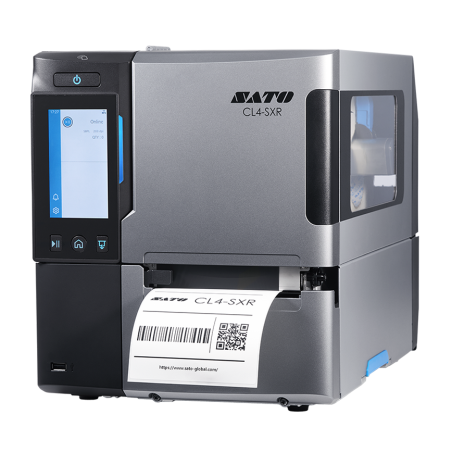
The image is for illustrative purposes only and may not fully reflect the characteristics of the actual product.
Industrial 4-inch SATO CL4-SXR for 609 dpi label printing and HF RFID encoding, featuring RTC, touchscreen operation, Ethernet/USB/serial connectivity and an EU power cable.
 Secure Payments
 Delivery policy
 Refund policy
The 609 dpi SATO CL4-SXR with HF RFID is a professional platform for producing a visible label and writing electronic information to a tag within the same workflow. Its 4-inch format is suited to businesses that identify assets, components, containers or records through automatic data capture. This configuration includes a real-time clock, standard media handling with a tear bar and an EU power cable. It provides an industrial yet manageable workstation for repeated jobs in which printed content must remain aligned with the information stored in the HF transponder.
The print engine supports both direct thermal and thermal transfer operation. Direct thermal is practical for labels with a controlled service life and no ribbon, while thermal transfer lets the user combine media and ribbon for an image selected around handling, storage and exposure requirements. Maximum print width is 104 mm. Media rolls can measure up to 220 mm in diameter and ribbons can be up to 600 meters long, reducing supply changes during busy shifts and helping operators maintain a steady production rhythm.
This version prints at 609 dpi, equal to 24 dots per millimeter, and reaches a maximum speed of 152,4 mm/s (6 ips). Its maximum printable length is 400 mm. It is positioned for fine graphics, very small characters and high-density codes. Resolution should not be selected on sharpness alone: label size, font height, code density, media, ribbon and required speed all influence the final result. Testing the real layout establishes a dependable production profile.
A 4.3-inch color touchscreen provides direct access to setup, operating status and diagnostics. With 8 GB of Flash memory and 2 GB of RAM, the printer can manage detailed formats, fonts, images and variable data. Interfaces include Gigabit Ethernet, USB 2.0 Type A and Type B, NFC, RS-232C and EXT. This set connects the CL4-SXR to industrial computers, ERP or warehouse systems, packing stations, readers and automation equipment while keeping a wired configuration that can be administered predictably by technical teams.
When SATO Online Services is activated and supported by the local infrastructure, the printer can participate in remote monitoring and predictive maintenance. Condition information helps maintenance teams plan action before a developing issue becomes unplanned downtime. A first-label waste prevention function also limits unused media when a job begins. High print precision supports repeatable positioning of visual elements and codes, an advantage for compact formats and recurring production runs where small registration changes may affect readability or downstream scanning.
Typical applications include asset identification, reusable-container labels, component traceability, document or sample management, inventory, order preparation and material control. HF must match the reader environment already installed or planned. This configuration does not include WLAN/Bluetooth, a cutter or a dispenser; it uses wired connectivity and a tear bar. That arrangement is appropriate for fixed workstations where an operator manually removes the label after printing and where network stability is valued over mobile placement.
A successful deployment starts by defining media dimensions and thickness, adhesive, inlay position, expected print life and application method. Supported media width is 22 to 128 mm, or 25 to 131 mm including the liner, with thickness from 60 to 268 micrometers. Ribbon width ranges from 39.5 to 128 mm. Media and ribbon must be compatible with each other and with the chosen print speed; settings validated for one construction should not automatically be reused for a materially different label.
Reference WWCLX380ZNAREU specifically identifies the European 609 dpi model with HF RFID, RTC and an EU power cable. Before ordering, the part number should be checked against the RFID architecture, tag format and required interfaces. Careful selection at the start helps the printer become a dependable part of the operation, with fewer adjustments, more consistent records and organized consumable management. The CL4-SXR brings industrial printing, HF encoding and operational control together in one device designed for sustained professional use.
The 609 dpi SATO CL4-SXR with HF RFID is a professional platform for producing a visible label and writing electronic information to a tag within the same workflow. Its 4-inch format is suited to businesses that identify assets, components, containers or records through automatic data capture. This configuration includes a real-time clock, standard media handling with a tear bar and an EU power cable. It provides an industrial yet manageable workstation for repeated jobs in which printed content must remain aligned with the information stored in the HF transponder. The print engine supports both direct thermal and thermal transfer operation. Direct thermal is practical for labels with a controlled service life and no ribbon, while thermal transfer lets the user combine media and ribbon for an image selected around handling, storage and exposure requirements. Maximum print width is 104 mm. Media rolls can measure up to 220 mm in diameter and ribbons can be up to 600 meters long, reducing supply changes during busy shifts and helping operators maintain a steady production rhythm.
Specific References
Industrial 4-inch SATO CL4-SXR for 609 dpi label printing and HF RFID encoding, featuring RTC, touchscreen operation, Ethernet/USB/serial connectivity and an EU power cable.


